Serious Sam: Shatterverse Biomes, Secrets, and Act II Anomalies
Handcrafted tiles, kill-all challenge rooms, eyeball doors, and the modifiers that start after Act I.
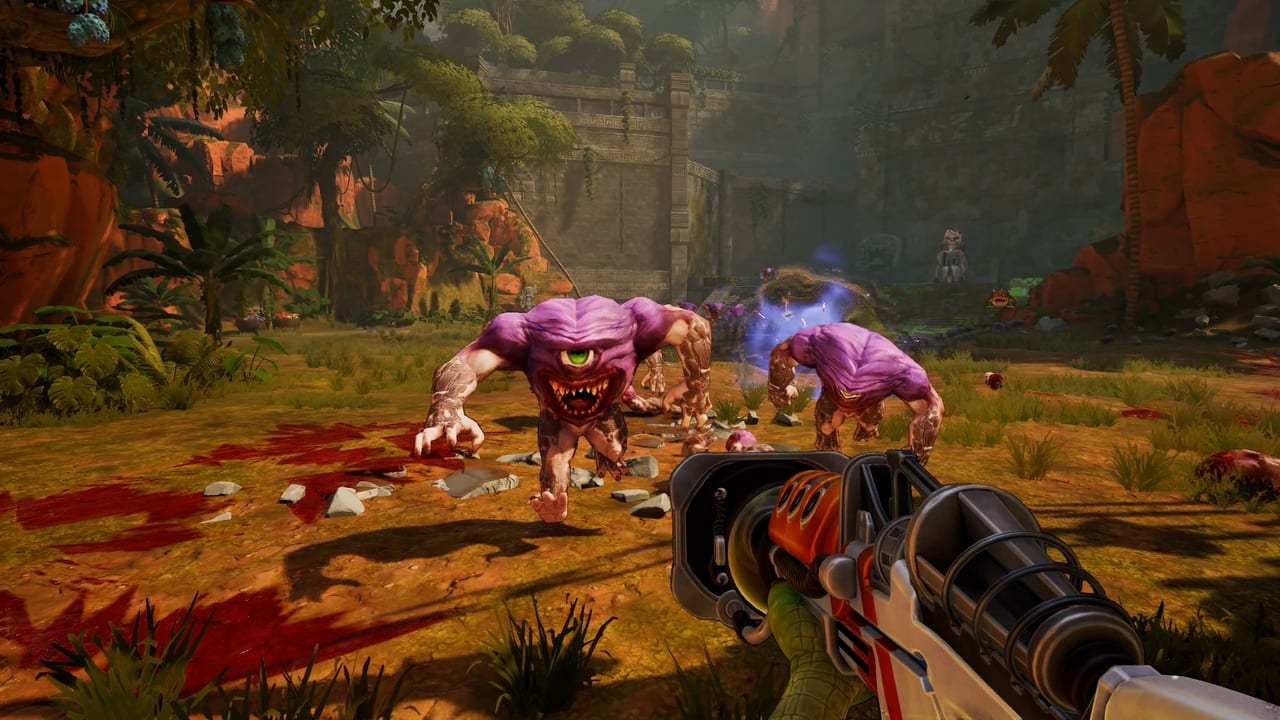
Serious Sam: Shatterverse does not send you down a campaign map list. Behaviour Interactive shipped a 1–5 player co-op roguelite FPS on August 31, 2026, and a run is a 45-minute chain: three biomes, three arenas each, lieutenant on the third. The places look like classic Sam postcards — jungles, ancient ruins and temples, castles, snowcapped mountains, lava volcanoes — but the connector between rooms is a shuffle, not a level select. Devolver Digital published it at $19.99 with no microtransactions. Unreal Engine 5 draws the tiles. You still backpedal through them.
This page is the geography of a run. It is not a promise that every night looks new. Steam sat Mixed at launch, about 47% of roughly 301 reviews, and repetition of those nine arenas is one of the named complaints. Analog Stick’s launch write-up already said the same two or three challenge rooms keep coming back. Treat biomes as a route with side rooms, not as a tourist brochure. Pair this with the getting started guide if you still wipe before biome two, and with the difficulty guide before you take the same tiles onto Mental.
How a run picks biomes
Each attempt rolls three biomes. Each biome is three arenas glued from handcrafted segments that the run then connects in a new order. You are not exploring a continent. You are walking a short chain of authored rooms with randomized doors, side pockets, and a boss tile at the end. Survive the third arena and the lieutenant for that biome is down. Do it three times and the run is a clear.
The Xbox gameplay trailer on this page is the honest picture: dense foliage, wide sightlines, and a horde that does not care which tile you are on. What the trailer cannot show is that Act I does not own the full postcard set. Analog Stick’s working theory — and launch play agrees — is that Act I keeps a smaller biome pool. Jungles and temples show up early. Castles, snow, and volcanoes lean later as you push acts. That is why the first two Serious clears can feel like the same vacation, and why a Mental climb suddenly drops you into lava you had only seen in a loading still.
Do not sprint the main path because the next lieutenant is the only thing on the HUD. Codex discoveries pay Catalyst Orbs when a new biome variant logs. Side rooms pay Dust and chests. A 45-minute run that ignores every door is how you stay poor and then blame the shop.
Act I versus later acts
Act I is the teaching map. Fewer biomes, fewer nasty modifiers, and a lieutenant you can still learn on Serious. The tiles are still authored: a jungle arena with a river lip is a jungle arena with a river lip, even if the exit door moved. Launch players reported the same opening rooms across nights. That is the shuffle working as designed, not a broken seed. If you wanted a new Croteam chapter every hour, the launch review already told you this is not that product.
Later acts add the rest of the postcard set and start stacking pressure on the same nine-arena skeleton. Snow arenas hide jump pads behind ice you have to shoot out. Volcano tiles put lava in the floor plan before the Lava Golem even loads. Castle courtyards give you pillars for Arachnoid volleys and then take them away on the next roll. The lieutenant still sits on arena three. Patterns for those fights live on the boss guide. Geography only decides whether you enter that fight with a secret chest or with empty vials.
Pushing acts is also how the roster of places stops feeling tiny. The multiverse pitch in the trailers sounds infinite. The shipped set is a handful of biomes that unlock as you climb. That is a fair critique and a useful routing fact: if you have not left Act I, you have not seen the full tile list, and you should not call the game six rooms forever until you have.
Challenge rooms
Challenge rooms are the kill-all closets. Clear every enemy in the pocket and the chests open. Loot is per-player, so a five-stack is not a race. The reward is extra guns, vials, and the kind of Dust that feeds hub trinkets. The tax is time and health. On Serious, take them. On a wounded Mental push, skip a room that sits behind a Harpy balcony if two Sams are already one execute from down.
Launch honesty: there are not many layouts. Analog Stick wished for more variations and then admitted seeing the same two or three almost every run. That is why challenge rooms feel like a slot machine with three pictures. They are still worth opening on a first Serious clear because Codex ticks and Orb scraps add up. They are less worth a wipe when the third arena is already a lieutenant you have not learned.
Call the room in co-op. One Sam holds the door, one Sam executes fodder, one Sam watches the spawn that always comes from the balcony you forgot. Role spread is on the co-op guide. Do not all dump ultimates into a challenge closet and then walk into Kleer God with empty bars.
Secrets, switches, and eyeball doors
Shatterverse still hides things for people who look up. Hard-to-reach switches, jump pads frozen behind ice, target switches behind crumbling statues, and eyeball puzzles that only open a door once you have tracked every eye in the room. None of this is a Metroid world. It is a 90-second detour that pays Orbs, Dust, and the occasional chest that is better than the Act I pistol the main path wanted to hand you.
Eyeball doors are the readable secret. If the wall has sockets and the room has glowing eyes on ledges, statues, or behind a grate, shoot or collect until the count matches. Do not leave one eye because a Gnaar pack spawned. The door will not pity you. In a squad, assign one Sam to hunt while the others hold the floor — Alien Sam is a terrible secret hunter; put Retro Sam or Broken Sam on the ledges and keep Quad Wield in the cone.
Ice jump pads are a shoot-first puzzle. Break the ice, use the pad, grab the ledge. Double jump helps; horizontal dash still saves more lives than a panicked second hop. Statue switches want a bullet, not a melee. If you are learning binds, the controls guide is the five-minute fix before you miss another pad because use and execute share a key.
Secrets are also why the Mixed-review “it is the same jungle” take is only half true. The jungle tile is the same. The ice pad you ignored last night is why you still have 40 Orbs.
Act II anomalies
Anomalies start in Act II. They are optional taxes that pay extra Dust for the trinket desk if you take them, and they are how a familiar temple becomes a different game for twenty minutes. Analog Stick called them a riot and then listed the handful that actually showed up in a launch review: third-person camera, no backpedal, vision obscuring, exploding corpses. Xbox Wire’s pitch for “unstable anomalies” is this list, not a live-service calendar. As of early September 2026 there is still no numbered post-launch patch, so what you see in Act II is what shipped.
Read the tax before you click yes:
- Third-person is funny until a Kleer swipe leaves the frame you are used to. Learn it on Serious, not as a first Mental modifier.
- No backpedal deletes the series’ oldest skill. You will spend dashes and you will miss executes. Skip it until you can clear a lieutenant walking forward on purpose.
- Vision obscuring is a readability fight stacked on Unreal clutter. If Rogue NETRICSA already feels messy, do not add fog for Dust.
- Exploding corpses are a blessing and a curse. Chains of Gnaars delete themselves. They also delete the wounded fodder you were about to melee-execute for a heal. If your heal plan is executes, this anomaly is a hunger tax.
Dust upgrades trinkets on the hub desk. That is real permanent progress. It is not worth a wipe on a first Serious clear. The builds and boons guide is where Dust and Intel discs meet. This page only tells you not to mortgage biome three for a stapler.
Enemy density still belongs to the tiles. Jungles hide hoppers in foliage. Temples give Arachnoids height. Volcanoes make Lava Golems honest because fire is already on the floor — and those golems are fire-immune, which the enemies guide covers before you waste a flame affix. Castles and snow are the vertical exams. None of that replaces lieutenant homework.
Walk the side rooms, shoot the ice, count the eyes, and treat Act II anomalies as a menu, not a dare. The biomes in Shatterverse are a short stacked set that grows as you push acts. That is smaller than the trailer language and larger than Act I. If the third arena still deletes you, the tile is not the problem — the boss guide is.
Frequently Asked Questions
Quick answers to the most common Shatterverse questions.
How many biomes are in a Shatterverse run?
Three biomes per run, three arenas each, lieutenant on the third. A full clear is about 45 minutes. The loop and Orb spending are in the getting started guide.
Does Act I use the full biome list?
No. Analog Stick noted fewer biomes in Act I, with jungles and temples early and more tiles (castles, snow, volcanoes) as you push acts. Difficulty climbing is on the difficulty guide.
What is a challenge room?
A kill-all pocket that pays chests if you clear it. Layouts repeat. Take them on Serious; skip them if the squad is one execute from a wipe. Squad habits sit on the co-op guide.
How do eyeball puzzles work?
Find every eye in the room so the door unlocks. Other secrets include ice jump pads and statue switches. Movement binds for pads and grapples are on the controls guide.
When do anomalies start?
Act II. Examples include third-person, no backpedal, obscured vision, and exploding corpses. They pay Dust for trinkets. Skip no-backpedal until you can already clear a lieutenant — see the boss guide.
Why do the maps feel repetitive?
Handcrafted segments reshuffle; the authored rooms stay the same. That repetition is part of the Mixed Steam score (~47% of ~301). Context is in the launch review.